
Case Study
Social landscape
Espresso Martini
Social Landscape
What features shape the audience’s world? Map the forces. Act where it matters.
The social landscape is a system of forces that defines how people think, behave, and ascribe meaning.
Emerging trends, social tension, new technology, and economics all contribute to growing expectations. A landscape is not a backdrop. It is the evolving environment where brands live and thrive.
Brands do not use culture as a resource. They participate as both cause and effect.
A socio-cultural landscape is your map of these diverse forces. It shows where attention moves and exposes the unmet needs that drive curiosity.
Friction and opportunity exist in their own locations, often side by side. These dynamics tell us where a brand must show up to meet the audience and give them what they want.
Relevance is more than aesthetic tuning. Cultural relevance means effectiveness. Campaigns are services. They address tension and solve problems. They give the audience hope.
Challenge
A major liquor brand was losing relevance within a shrinking category. Alcohol consumption was declining overall, yet the espresso martini was delivering sustained double-digit growth.
The issue was not invention, but entry. The brand required a credible route into a growing ritual without claiming ownership of it.
Approach
-
What occasions, people, and needs actually drive interest?
How do conversations and audience behavior signal where relevance is forming?
-
Which signals are shaping emerging trends and territories?
What unified driver or unmet need define each territory?
-
Where is the clear need a brand can credibly meet?
How can the brand gain access in a way that feels organic rather than a power grab?
-
How do we ensure ideas are feasible, not just compelling?
In workshops with stakeholders and creatives, ideas are stress tested in real-world scenarios.
Process
Joining a Ritual with Credibility
Two years of social data reveal emerging forces likely to continue growing over the next year, more than enough time to develop and activate a response.
Unmet needs are entry points for any brand. Brandwatch enables us to track the occasions, people, and contexts that define interest across moods and modes of consumption.
Semiotic analysis then identifies the signals shaping trends and territories. Behind each territory sits a unified driver of need. To ensure the message resonates, an innovation workshop tests the feasibility of each strategic direction.
Insight
Gen Z does not like to break rules. They wait until it feels socially safe to bend them.
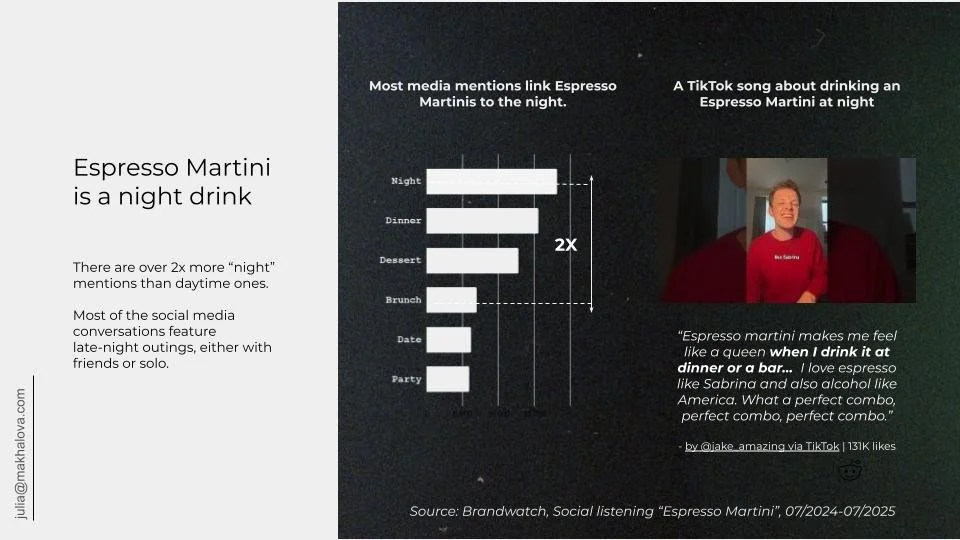
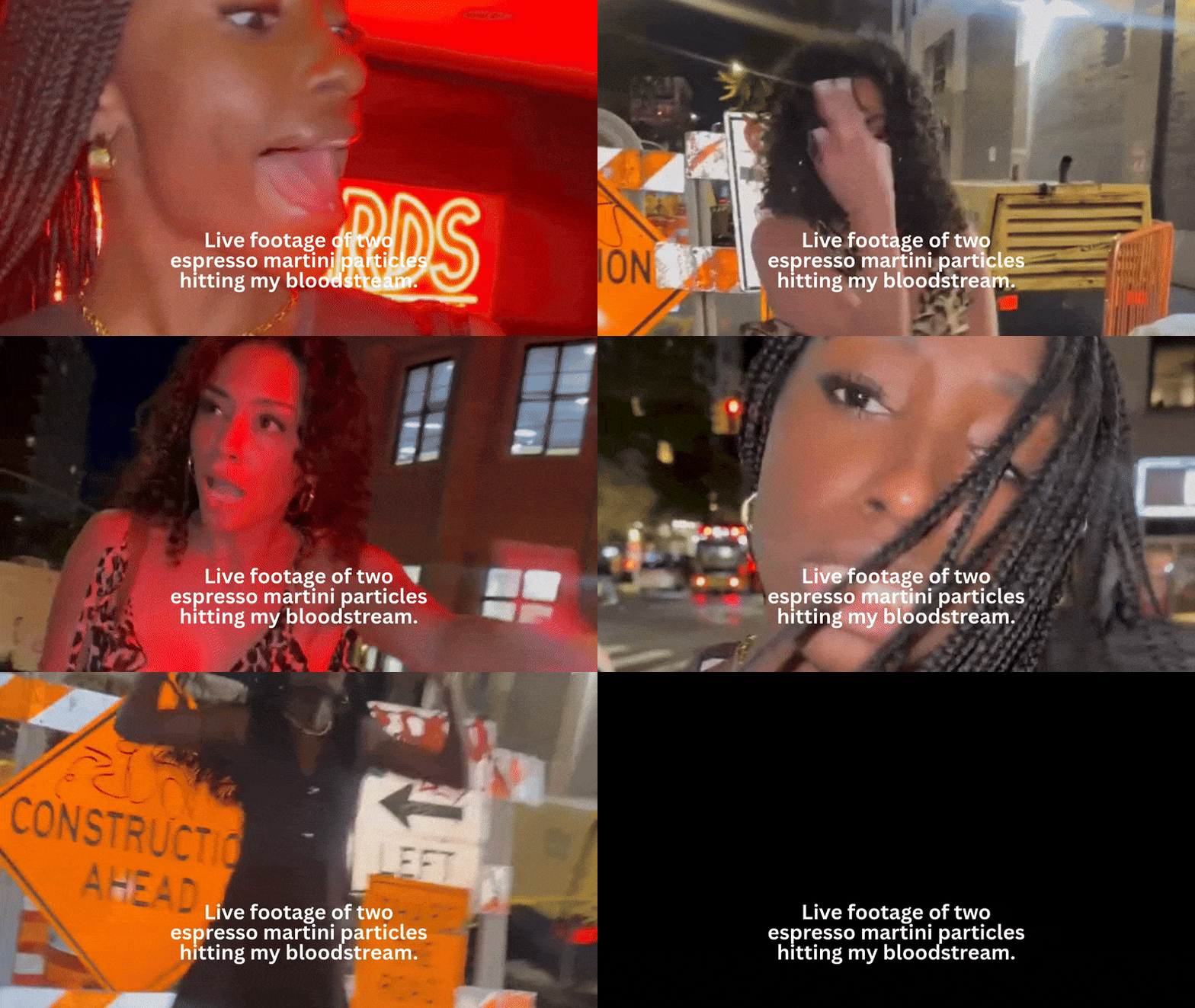
Coffee is “not for after 4 p.m.” Yet the espresso martini is a night drink. When people saw others ordering it after dark, the shift was acceptable.
The brand did not encourage rebellion. It made the exception feel normal. It formalized naughtiness and provided social cover. The product became a sanctioned way of crossing a line.
Impact
By decoding the espresso martini, the BrandBackstage identified a credible route into an established night ritual.
The strategy prioritised relevance over scale. The brand entered the occasion on its own terms, participating without reframing the ritual or overstating its role.