

Case Study
POINTS-OF-INFLUENCE STRATEGY
BrandBackstage X NEW YORK IMMIGRATION COALITION X mount sinai human rights Program

In June 2026 Project Ripple has been named an Honoree in Fast Company's 2026 World Changing Ideas Awards.
This annual recognition honors bold efforts that take on the world's most pressing problems, spanning AI, financial inclusion, healthcare, and social impact.
Where is the one open door?
A points-of-influence strategy identifies the single channel where trust, privacy, and existing participation have already converged, then builds upon that model to plot measured change.
Challenge
Immigration was prominent in New York City's public conversation in 2025, and the people most affected were rarely part of that conversation.
These were not hard-to-reach people, but simply people with understandable anxiety about engaging with established institutions. For immigrant communities shaped by global conflict, the unmet need was mental health support, and many cultures stigmatize accepting help from outsiders.
Approach
-
What occasions and contexts shape how the community navigates the city?
How do conversations shift when a subject carries stigma?
-
Where do trust, privacy, and existing participation already converge?
Which channel can carry something the community has not yet asked for?
-
Which institutions already hold credibility within the community?
How can existing systems be connected rather than replaced?
-
Workshops with NYIC and clinical partners tested strategic options against real community conditions before execution.
Process
Routes into the community were tested against three conditions:
Trust - Is the message safe?
Privacy - Can we create conditions where stigma can be overcome?
A reason to show up - What is immediately useful?
Community events failed on privacy. Outreach programmes failed on trust. Schools passed all three. They were also, as school directors confirmed, where the need was most acute. Children were acting out. Teachers could not read it. Counsellors lacked training in war-related trauma.
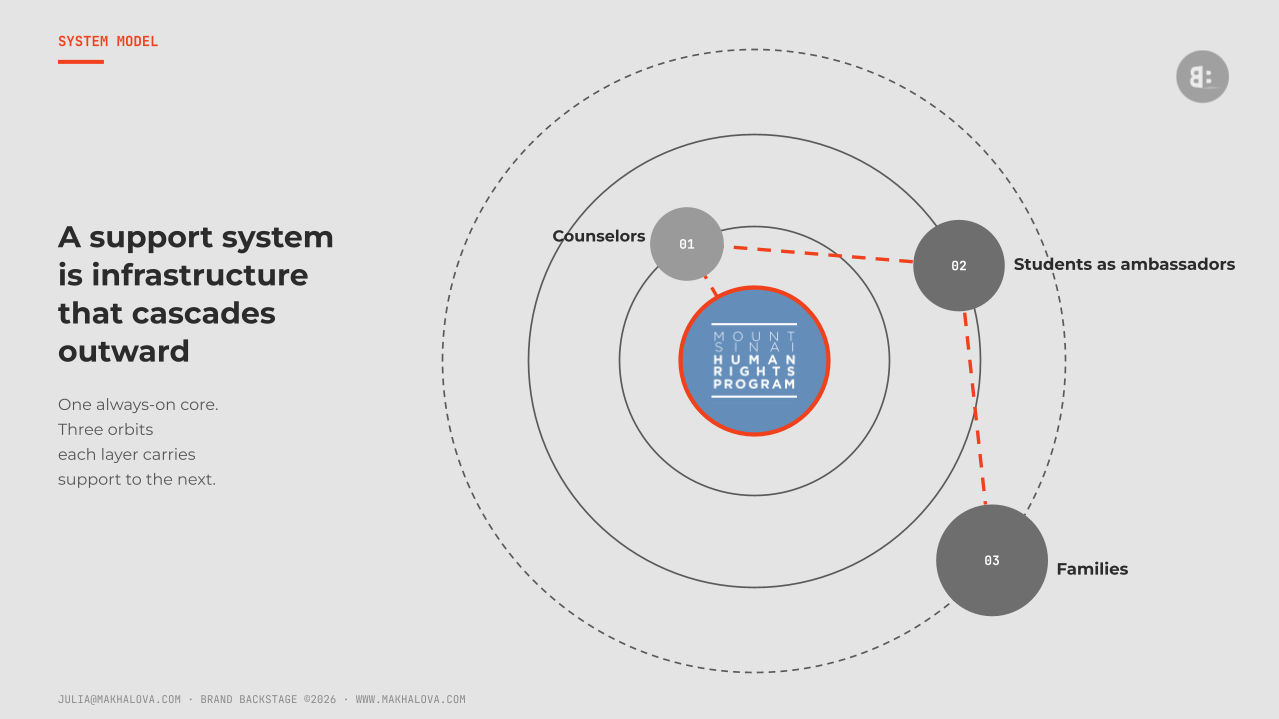
In partnership with The Mount Sinai Human Rights Program, a ripple model was built. Clinical specialists trained school counsellors. Counsellors carried purpose-built materials to parents and community members, reaching the people least likely to ask for help through the people they already trusted.

“Children exposed to conflict and forced migration can benefit from trauma-informed intervention, however they may also encounter barriers to access.
Schools are uniquely positioned to offer culturally responsive, developmentally appropriate, and non-stigmatizing services to respond to their needs.
Teachers, administration, and staff serve as essential bridges to resources that may support the health and wellbeing of refugee children and their families."
Dr. Kim Baranowski, Program Partner; Associate Director, Mount Sinai Human Rights Program.
Insight
The community was not closed to help. It was closed to strangers.
Schools were the one institution that was neither. By equipping counsellors to handle the classroom layer, then enabling children to become carriers who brought resources home to their families, the model created a cascade rather than a campaign. Mental health support delivered not as a service, but as a relationship that already existed.
Impact
Strategic focus shifted from direct provision to ripple infrastructure.
Help arrived through the child rather than asking an adult to admit something was wrong.
Strategic focus shifted from direct provision to ripple infrastructure. Counsellors gained tools to read and respond to trauma. Materials reached parents through trusted intermediaries. The model was built to grow with the network.
1 unified knowledge resource designed by The Mount Sinai Human Rights Program
15 core partner organizations and schools onboarded
2,500 community caregivers reached and trained